As digital transformation accelerates across retail, education, transportation, and corporate environments, businesses are increasingly adopting advanced visual display technologies to communicate, advertise, and engage users.
Two of the most commonly used solutions are:
Although they may look similar at first glance, they serve very different purposes. Choosing the wrong solution can lead to poor user experience, wasted investment, and low ROI.
This guide provides a clear comparison between digital signage and interactive displays, helping distributors, system integrators, and project buyers choose the right solution for their business needs.
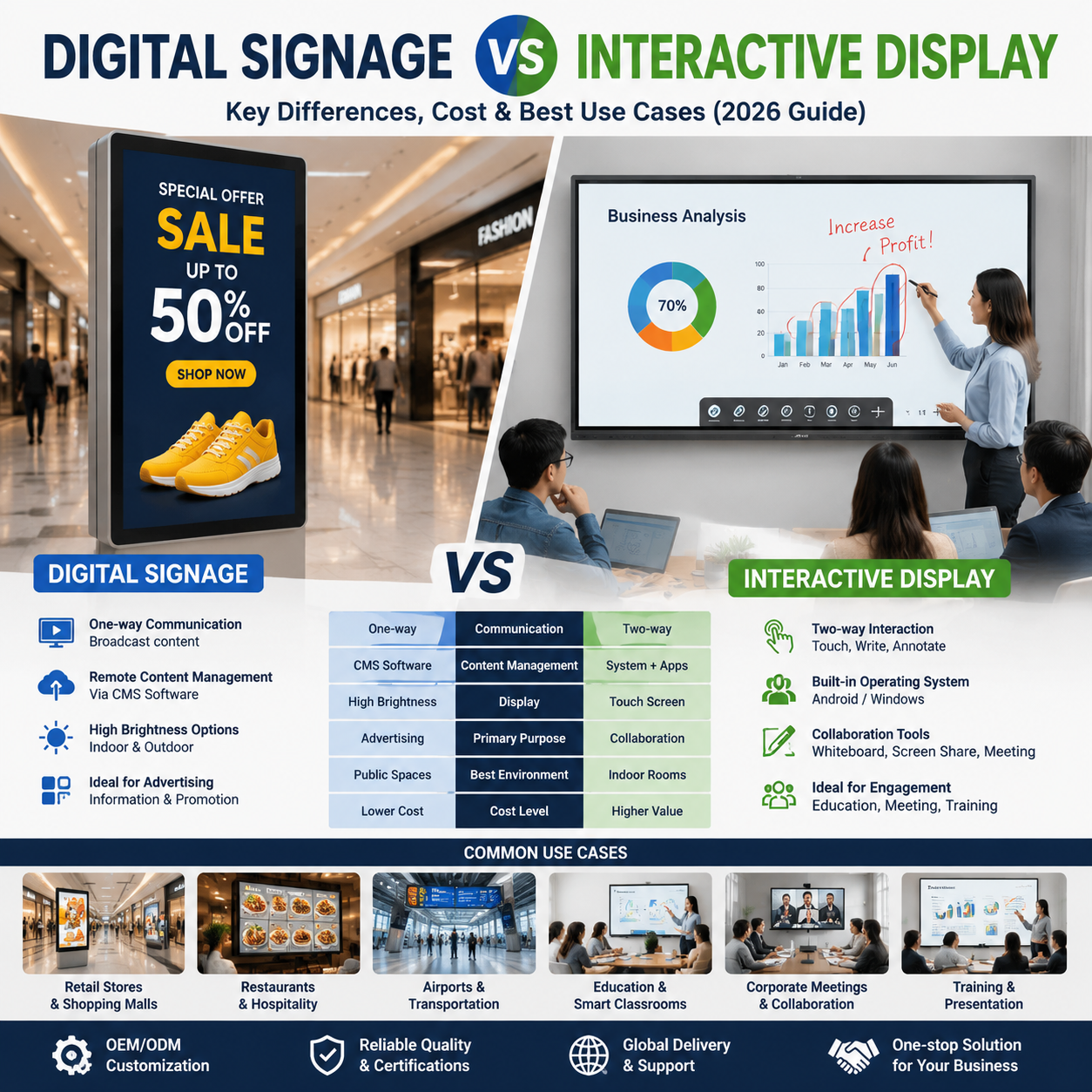
Digital signage refers to a display system used for broadcasting static or dynamic content such as advertisements, announcements, menus, or promotional videos.
It is a one-way communication tool, meaning users typically only view content without interacting with it.
Remote content management (CMS)
High-brightness screens for visibility
Supports video, images, and text
Works 24/7 in public environments
Commonly used in advertising networks
Shopping malls
Retail stores
Airports and train stations
Restaurants and fast-food chains
Outdoor advertising billboards
Digital signage is primarily designed for attention capture and information broadcasting.
An interactive display (also called interactive flat panel or smart board) is a touchscreen-based system that allows users to directly interact with the content on the screen.
Unlike digital signage, it enables two-way communication.
Multi-touch screen (10–40 touch points)
Built-in Android or Windows system
Annotation and whiteboard tools
Video conferencing integration
Screen sharing from mobile devices
Education classrooms
Corporate meeting rooms
Training centers
Government offices
Collaboration environments
Interactive displays are designed for engagement, collaboration, and participation.
To better understand which solution is right for your project, here is a detailed comparison:
Digital Signage: One-way communication (broadcasting content)
Interactive Display: Two-way communication (user interaction)
Digital Signage: No touch or limited interaction
Interactive Display: Full touch interaction and writing capability
Digital Signage: CMS-based content management system
Interactive Display: Android/Windows operating system with apps
Digital Signage: Advertising and information delivery
Interactive Display: Collaboration and engagement
Digital Signage: Public spaces, retail, outdoor environments
Interactive Display: Indoor meeting rooms and classrooms
Cost varies depending on size, brightness, system configuration, and customization level.
High brightness panel (outdoor/indoor)
Weatherproof design (for outdoor units)
CMS software integration
Mounting structure
Touch panel technology
Operating system (Android/Windows OPS)
CPU and memory configuration
Whiteboard software integration
Digital signage is usually more cost-efficient per unit
Interactive displays have higher value-added features, resulting in higher price but better engagement ROI
Digital signage plays a critical role in modern retail environments.
Promotional product displays
Dynamic pricing updates
Brand storytelling
In-store advertising
Outdoor billboards
Shopping mall media walls
Transportation hubs
Eye-catching visuals
Centralized content control
Scalable advertising network
High passive engagement
Digital signage is ideal for mass communication and brand exposure.
Interactive displays are transforming modern collaboration environments.
Smart classrooms
Digital lesson delivery
Student engagement tools
Remote learning integration
Video conferencing
Team collaboration
Project presentations
Training sessions
Improves engagement
Enhances communication
Reduces training time
Supports hybrid work environments
Interactive displays are ideal for active participation and collaboration.
Choose digital signage if your goal is:
Advertising content delivery
Public information broadcasting
Retail promotion
Outdoor visibility
Large-scale content distribution
It is the best solution for:
Retail chains
Advertising agencies
Transportation systems
Hospitality industry
Choose interactive display if your goal is:
Training and education
Team collaboration
Interactive presentations
Video conferencing
Digital classrooms
It is best for:
Schools and universities
Corporate offices
Government institutions
Training organizations
For B2B buyers, working directly with an OEM/ODM manufacturer provides significant advantages in both product flexibility and cost efficiency.
Logo customization
UI interface branding
Startup screen customization
Packaging design
CPU configurations
RAM/storage options
Brightness adjustments
Touch technology selection
Manufacturers can support:
Government projects
Education deployments
Retail chain rollouts
Distributor stock programs
Consistent product supply
Firmware updates
Technical support
Spare parts availability
Both solutions provide strong ROI but in different ways.
Higher advertising exposure
Lower operational cost
Scalable revenue model for advertising networks
Higher productivity in meetings
Reduced training costs
Improved learning outcomes
Increased collaboration efficiency
Ultimately, ROI depends on use case rather than product alone.
Some models support touch, but they are still primarily designed for passive display.
Yes, but they are not optimized for large-scale public advertising.
Digital signage is better for promotions, while interactive displays are better for customer engagement zones.
Yes. Digital signage uses CMS systems, while interactive displays support remote software management.
Yes, OEM/ODM customization is available for both product categories.
Digital signage and interactive displays are both essential components of modern digital transformation, but they serve very different purposes.
Digital signage is best for broadcasting and advertising
Interactive displays are best for collaboration and engagement
For distributors and system integrators, offering both solutions allows you to cover a wider range of commercial opportunities.
Choosing the right manufacturer ensures product consistency, customization flexibility, and long-term project success.
If you are looking for a reliable OEM/ODM manufacturer for digital signage or interactive display solutions, contact us today:
Get product catalog
Request project quotation
OEM customization consultation
Distributor partnership program
Technical support for integration
Start building your commercial display business with a trusted factory partner.

Contact: Andy Young
Phone: +86 13257697588
E-mail: sales@kingonevision.com
Whatsapp:+86 13257697588
Add: Building 4, Zhongju Industrial Park, Wanjiang Street, Dongguan, China
We chat