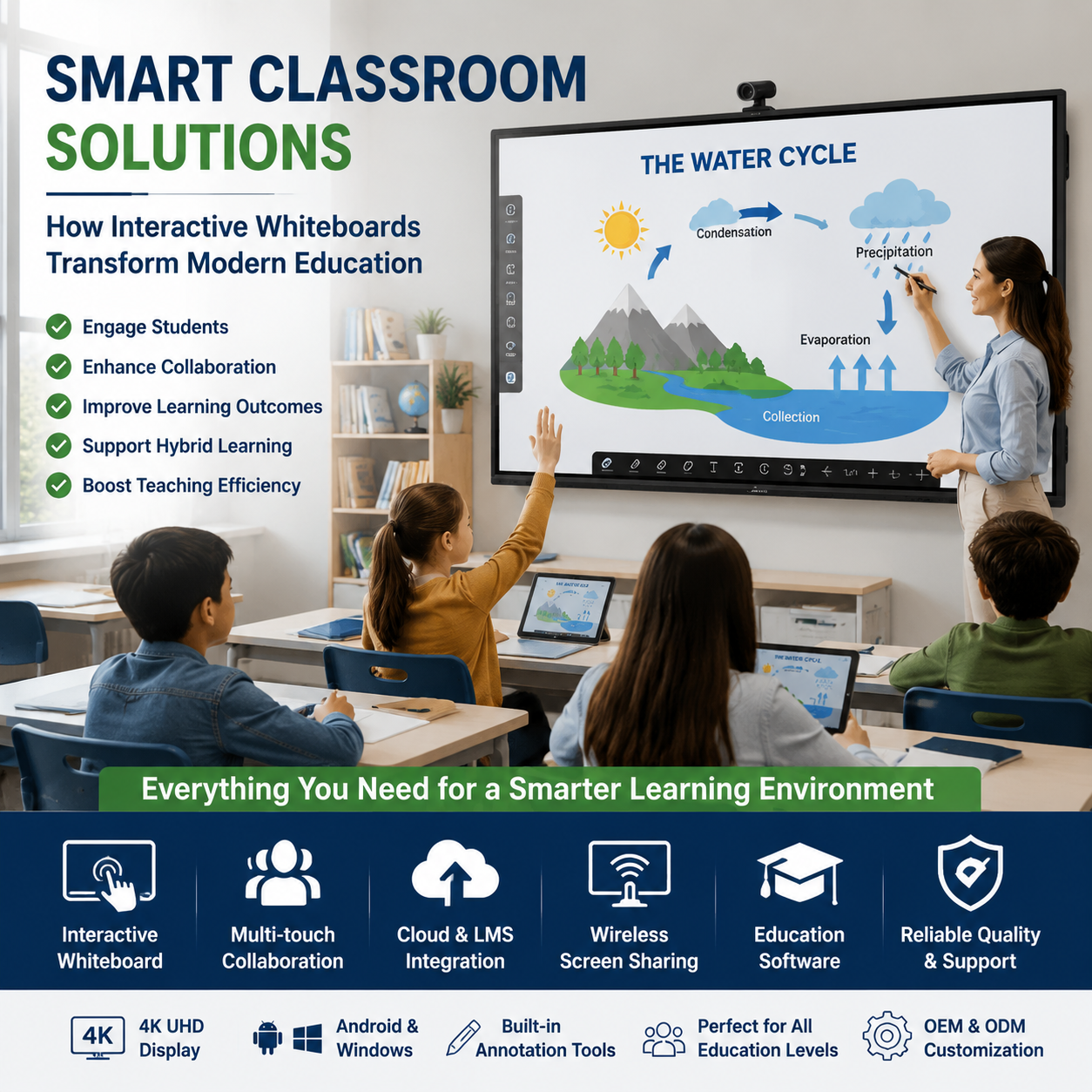
Education is undergoing a major digital transformation. Traditional chalkboards and projection systems are rapidly being replaced by interactive technologies that improve engagement, collaboration, and learning efficiency.
Among these technologies, the interactive whiteboard has become the core component of modern smart classrooms.
Schools, universities, and training institutions worldwide are investing in smart classroom solutions to improve teaching quality and prepare students for a digital future.
This article explains how interactive whiteboards transform education, what features matter most, and how OEM manufacturers support large-scale school deployments.
Despite advancements in education systems, many classrooms still rely on outdated teaching methods.
Traditional lecture-based teaching often leads to passive learning, where students simply listen without interaction.
Chalkboards and projectors cannot support multimedia learning, real-time collaboration, or digital content integration.
Studies show that students retain more information when they actively participate in learning rather than passively observing.
Traditional classrooms are not designed for hybrid or online learning environments.
These challenges highlight the need for smarter, more interactive education solutions.
A smart classroom is a digitally enhanced learning environment that integrates technology into teaching processes to improve interaction and efficiency.
It typically includes:
Interactive whiteboard or smart board
Teacher and student devices (tablets, laptops)
Cloud-based learning platform
Audio-visual systems
Wireless connectivity
The goal is to create a collaborative, engaging, and technology-driven learning environment.
The interactive whiteboard is the central hub of a smart classroom system.
Digital writing and annotation
Multimedia presentation (video, images, documents)
Real-time interaction between teacher and students
Screen sharing from multiple devices
Integration with educational software
Unlike traditional teaching tools, interactive whiteboards allow teachers to dynamically adjust lessons based on student interaction.
When selecting an interactive whiteboard for education, several key features must be considered.
Supports multiple students interacting simultaneously, promoting collaborative learning.
Ensures clear visibility even in large classrooms.
Android system for easy teaching tools
Windows OPS for advanced applications
Allows teachers to annotate, draw, and save lesson content.
Students and teachers can share content directly from laptops or mobile devices.
Reduces eye strain during long learning sessions.
Interactive whiteboards can be used across multiple education levels.
Interactive games
Visual learning content
Basic writing exercises
Science simulations
Mathematics problem solving
Group discussions
Lecture presentations
Research collaboration
Hybrid learning sessions
Corporate training
Skill development workshops
Certification programs
Modern smart classrooms are no longer standalone systems.
Interactive whiteboards integrate with:
Cloud-based learning platforms
Video conferencing tools (Zoom, Teams)
Learning Management Systems (LMS)
Digital assignment platforms
This enables:
Remote teaching
Lesson recording
Content sharing across classrooms
Centralized school management
Interactive lessons improve attention and participation rates.
Students understand concepts faster through visual and interactive content.
Teachers can prepare, deliver, and reuse digital lesson materials.
Less need for printed materials and physical teaching aids.
Enables both in-person and online education models.
For education projects, working with an OEM/ODM manufacturer provides significant advantages.
Screen size (55–98 inch)
CPU/RAM options
Android/Windows system integration
School branding UI
Pre-installed educational apps
Local language support
Manufacturers can support:
Government education projects
School district rollouts
Private education chains
Firmware updates
Spare parts availability
Remote troubleshooting
A school deploying smart classrooms may implement:
75-inch interactive whiteboards in each classroom
Centralized content management system
Teacher training programs
Cloud-based lesson storage
40% increase in student participation
Improved test performance
Reduced teaching preparation time
Enhanced digital literacy
While smart classroom systems require initial investment, the long-term return is significant.
Reduced printing and paper usage
Lower maintenance compared to projectors
Longer equipment lifespan
Better student outcomes
Higher engagement
Improved teaching efficiency
Enhanced school reputation
Attracts more students
Supports accreditation standards
75 inches is the most commonly used size for standard classrooms.
Yes, interactive whiteboards offer better brightness, clarity, and functionality.
Yes, it supports video conferencing and cloud integration.
Yes, OEM customization includes software, branding, and hardware configuration.
Typically 50,000–60,000 hours depending on usage.
Smart classrooms are redefining modern education by combining technology, interaction, and digital content delivery.
The interactive whiteboard plays a central role in this transformation, enabling more engaging, efficient, and collaborative learning environments.
For schools, system integrators, and education solution providers, choosing a reliable OEM manufacturer ensures long-term stability, customization flexibility, and successful project deployment.
If you are planning to build or upgrade a smart classroom system, contact us today for:
Free education solution catalog
OEM interactive whiteboard customization
School project quotation
Distributor partnership program
Technical consultation for large deployments
Build the future of education with a trusted smart display manufacturer.

Contact: Andy Young
Phone: +86 13257697588
E-mail: sales@kingonevision.com
Whatsapp:+86 13257697588
Add: Building 4, Zhongju Industrial Park, Wanjiang Street, Dongguan, China
We chat